
NERD Production sat down with Christine Peters to discuss her creative approach to developing character designs for a range of very verified briefs.
Christine Peters has shaped a career out of designing characters that are overflowing with flair and personality which shape and drive memorable narratives. She brings iconic characters to life through the medium of animation such as Netflix’s mega hit ‘Stranger Things’.
In this feature from NERD Production Christine discusses her creative approach to developing character designs for a range of very verified briefs.
BRINGING THE CREEPY WORLD OF ‘STRANGER THINGS’ INTO A 2D SETTING
Christine starts things off by going back in time to 1980s Hawkins India as she discusses how she brought to life the dark world of ‘Stranger Things’. Where she had the monumental task of creating animation for one of the most popular TV series ever.
Q: First of all, were you already a fan of the series and how much did that influence your creative choices?
Christine> I absolutely loved the show long before we got to work on the teaser. Watching the show over the years we had a really good understanding of how the actors’ features changed as they went from children to young adults. We focused on the first season so we rewatched the series from the beginning. From the outset we and the client were aligned in wanting to really capture their likenesses in a more simplified form – a more life like anime style.
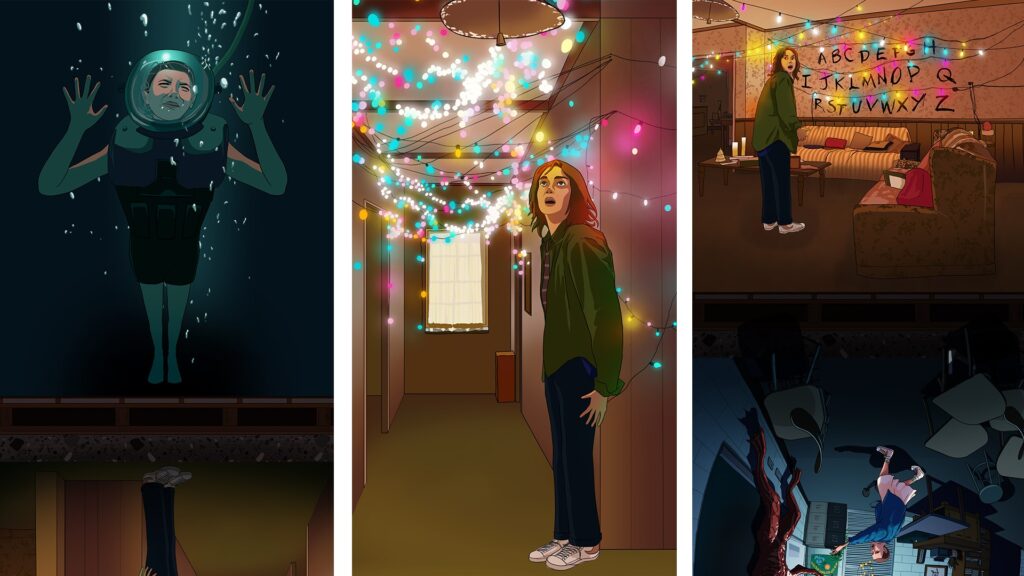
Q: Did you draw inspiration from any other famous pieces of pop culture when creating the look and feel for this animation teaser trailer?
Christine> I particularly loved the retro look and grading of the show; the use of bright pop art colours and the distinctive lighting really informed how we went about designing the overall look. When designing Eleven and Joyce Byers I really wanted to get the likeness just right whilst also leaning into ’80s style anime. Unbeknown to us when we began, we needed to get Winona Ryder’s team to sign off her character design before moving onto animation. It was such a great feeling to get this signed off in the first pass, she is the ultimate 1980’s icon!
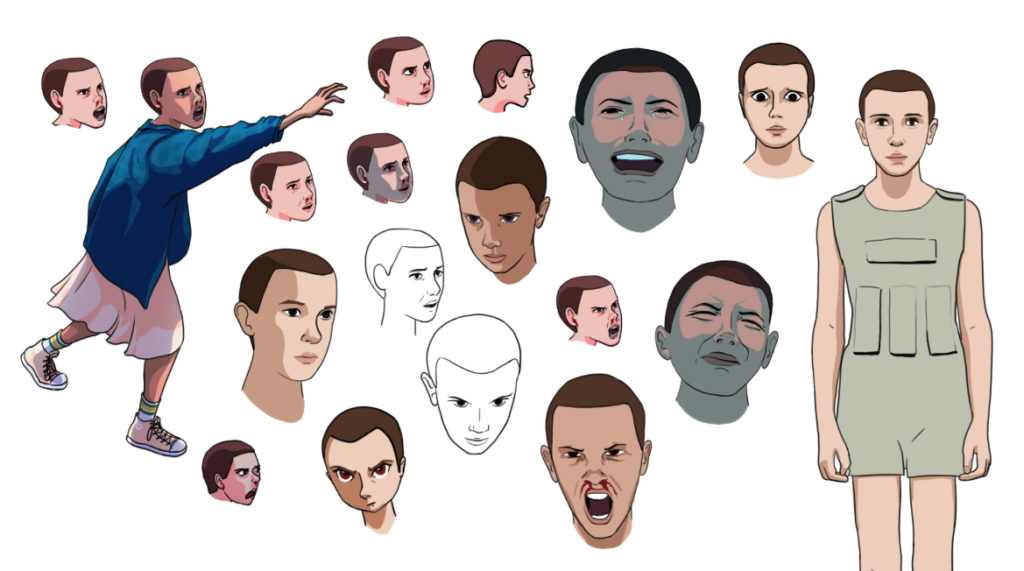
Q: Does the prep change when working on transporting actors into the world of animated characters?
Christine> Definitely, the groundwork for creating a character is already laid. We already know what drives them, what they like and dislike, their range of emotions. With ‘Stranger Things’ we had such a large back catalogue to reference from. With most other projects that we design that we create character designs for, it is unusual to have so much pre-existing material to work with.
On Continental for instance the character designs we came up with initially informed the casting of the actor they got in for the live action segments of the film. We then tweaked the design to get the likeness of the actor. The live action element ended up being shot halfway through the animation process, so we had his casting photography and looked through his previous work to inform our designs of him.
THE PROCESS OF DEVELOPING CHARACTER DESIGNS
In this section Christine discusses her process on creating character designs that she’s pitching on vs character designs that come to her through scripts.
Q: The ‘Stranger Things’ script was something you worked on pitching, how would the creative process differ from a script that comes to you?
Christine> Typically the client or agency will approach us with a script or an idea that we then go on to develop together. Sometimes that involves tweaking the script, or elaborating on the story by doing a very initial storyboard.
I find storyboarding a particularly fun stage, you can really get a feel for the pacing and how well an idea translates visually from the script. You can easily play with the narrative, chop bits out, slide things around and really hone into the story you are trying to tell.
For the Continental spot this was especially true; once we had the first draft of the storyboards finished it became clear what was and was not working. We swapped scenes and tweaked the staging of shots to build more tension of foreboding and the magic was born.
ORIGINAL CHARACTER DESIGN’S AND DEVELOPING AS A DIRECTOR
Q: What’s the first step you take when coming up with new and original character designs?
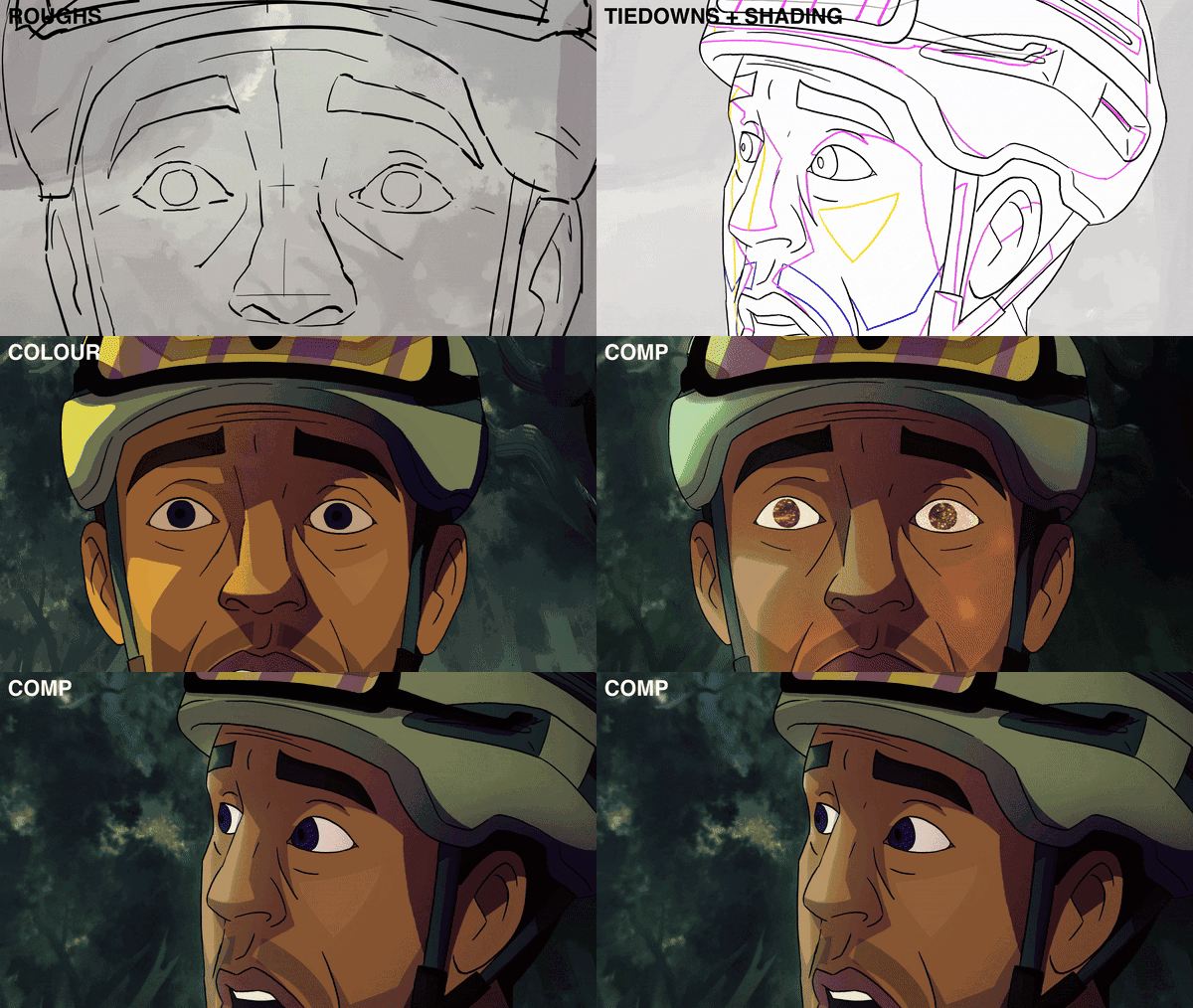
Christine> On most projects I have directed storyboarding and character design happen simultaneously. For storyboarding it is about the framing of the picture, the gestures, camera lenses and angles, whilst character design is much more specific, honing in on the overall look of the character and the poses they take on to illustrate who they are. Before committing pen to paper I will brainstorm who I think the character is, taking what I can from the script and building up a more detailed picture of who they are. I will start off with some very basic shapes, creating contrast and playing with scale – very much in the realm of doodling.
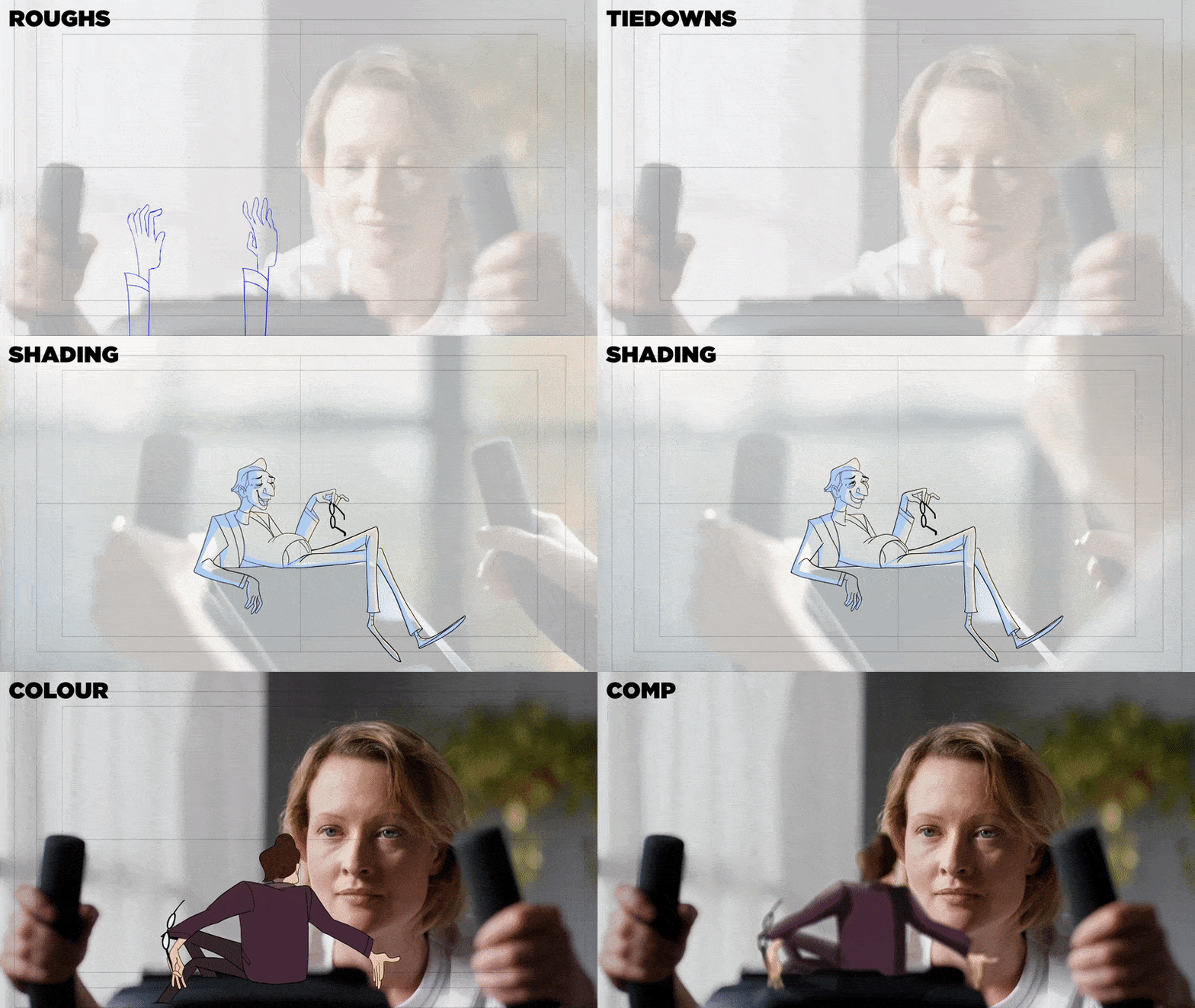
For Arden we actually didn’t have a storyboarding phase as such as the live action had already been shot before we started pre-production. Instead we set about character designing with a rough idea of where the tiny critic Tarquin would be in each shot. Once this was locked down we set about drawing up style frames with him in key poses. These were lit and composited roughly for each shot. It ended up being a really close collaboration between concept artists and the animators.
Q: What skills have you learnt from doing other roles that have shaped you as a director?
Christine> In the past, having worked at a very small animation studio gave me the opportunity to be hands-on at every stage of the animation process. I have always tended towards more narrative based animation, and took a short course in storyboarding at Central Saint Martins at the beginning of my time there. This skill has been invaluable throughout my career – understanding how to communicate stories through images, and also how to brief a storyboarder to bring a vision to life.
Having gotten to work at every stage in the animation process it has given me a solid understanding of the animation process from 2D, motion graphics to 3D. I am always looking to push what can be achieved visually, integrating 3D elements into traditional animation via backgrounds and compositing. To create the look for Arden’s character Tarquin we took mattes made in TVPaint and pumped them through a Cinema4D setup to generate soft highlights and shadows in line with the footage to composite him into the shot.
Q: What tool or piece of technology do you enjoy using the most when developing the character?
Christine> Either a pencil and paper or my trusty portable Cintiq, plus pinterest is a goldmine for collecting inspiration for look, clothing and general vibes. I’ve been lucky enough to have gotten to paint up characters with ink or watercolour which is always a treat. Back at my old studio we had a giant cork board for pinning ideas and drawings, there’s something rather special and tactile about having the collection of images right in front of you to piece together a project. If not then a gigantic Miro board will suffice.
Q: What do you think makes memorable character design?
Christine> The most memorable characters to me are the ones where I have had the most visceral emotional reactions to. The first being the Devil from Fantasia, as a child this would guarantee me being in floods of tears at the sheer terror of this section of the film. The Devil is designed with such a strong angular silhouette and posing, it amplifies his role in the narrative tenfold. This character has really informed the design decisions in my own work such as the design of the main character for Arden University. His spikey nature and posing emphasise his role in the story; gently prodding at the woman’s insecurities and perceived lack of confidence.
Another character that I have come back to time and time again is the Snowman, another classic from my childhood. The soft and friendly shaping of the character is enhanced further with the hazy pencil rendering, playing up to the notion that rounder shapes are more friendly, safe and cute. It plays into how we are wired, the reaction we find ourselves having when faced with babies and young animals with their large eyes and rounded proportions. It makes the viewer empathise with the child and snowman alike, the warm and safe feeling you get with this protective character. It makes it all the more devastating when the sun rises and the inevitable happens.
These two characters are very much opposite ends of the spectrum, the character designs they have been given really hammer home the emotional connection the viewer has to them.